Monday, May 28, 2012

Anniversary cruise travelogue

To celebrate our 32nd anniversary, Susie and I went on a Mediterranean cruise. This blog entry is my attempt to give a bit of a flavor for our trip. I apologize for how long it took me to write this entry, but it took some work to distill a week and almost 1,500 photos down to something anyone might be willing to read! I am trying to figure out the best place to put the photos (under 200 now) given that my preferred photo place (Kodak Gallery) is shutting down soon. 

We flew to Rome on Friday (May 11) and arrived on Saturday. As we had been to Rome before, our main goal was not to see anything in particular, but rather to try and stay awake until at least 9:00pm to get acclimated to the time zone (off by six hours). Our hotel (La Griffe) was in the middle of everything, so we spent much of the day walking to typical sights like the Trevi Fountain (which was mobbed and looked sort of like a mosh pit with some stone horses and water in the middle). We saw lots of churches and fountains as well as mobs of people including some dressed as Roman soldiers and others painted silver like statues. At the Coliseum we encountered a parade of communist protestors. They were doing lots of chanting and singing of slogans in Italian. It added a bit of festivity to our walk around the building.

On Sunday we attended an Episcopal church with services in English right near our hotel. The church, of course, was beautiful and was probably older than anything in our area. We then took a shuttle to our cruise ship. We managed to get on to the ship fairly uneventfully. I had hoped to get a table for two for dinner, but that did not happen. As I feared, we had to meet people. As I never would have guessed, we got along very well with the couple (Donna and Mark). We enjoyed spending dinner with them every night as well as doing a number of things on board the ship. As is often the case, I was wrong! They taught us a song to sing when that happens. The third couple (from Budapest) showed up one evening, but never again. I think they decided to not join our tight-knit foursome.

The first stop was on Monday in Messina, Sicily. I confess that my European geography is fairly weak. I did not realize that the distance from Sicily to Italy was only three miles. We took a tour that went to Mount Aetna, an active volcano. There was no molten lava to see, but as the bus went up the mountain, more and more of it was black from previous eruptions. The tour guide would say things like, “Over there is where the 2002 eruption happened and right up ahead is the end of the lava flow from 1998.” It was all rather surreal and hard to comprehend what it would be like to live in the shadow of a volcano. We also visited a beautiful sea coast town, Taormina. We walked down its main street, looked down or up the many quaint side streets, stepped into a number of churches, and enjoyed a bite to eat at an outdoor cafĂ© while watching people walk by. It was a wonderful day.

We spent Tuesday at sea. That meant we read, Susie climbed the rock wall, we went shopping, and I played in a volleyball tournament. In the evening we dressed up for one of the formal dinners. It was a nice relaxing day that let us get some much needed rest.
On Wednesday we docked near Ephesus, Turkey. For me, I think that stop was the highlight of the trip. The ruins at Ephesus were amazing. Not amazing in the way that the Coliseum is. The Coliseum is imposing enough that you come away wondering how was it possible that people could build something that big almost 2,000 years ago. But, the Coliseum is in the middle of a large city and it is hard to picture what it must have been like in its day.  Instead, Ephesus consists only of ruins and has enough intact or restored buildings that you can get a general sense what it was like. We walked past the bazaar, strolled down the crowded main street, walked into the library, viewed what the tour guide described as the gentlemen’s club, and saw the 24,000-seat arena. As the picture shows, none of the buildings was intact, but it gave a real sense of what it would have been like when Paul was there. We also visited a place where Jesus’ mother Mary supposedly lived for a few years, the ruins of a church where the Apostle John is purported to be buried, and a demonstration of Turkish rug making. 

On Thursday, our 32nd anniversary, we visited Athens, Greece. We had been there 28 years ago when Becky was two years old and Susie was pregnant with Nathan. One of my favorite memories of that visit was Becky sitting amongst small pieces of the stone from Parthenon saying, “Fee-fi-fo-fum, I smell the blood of an Englishman!” Back in the present, we took a tour that went to the Acropolis and some other sites in the city. The Acropolis was the obvious highlight. The somewhat intact buildings there, including the Parthenon, make a real impact. The impressive structures were largely built around 2,500 years ago. Much of the site, however, is being worked on to try and restore it. Part of that means taking down earlier (incorrect) attempts to reconstruct the buildings. There is scaffolding on many of the buildings which detracts a bit. Regardless, the buildings are quite amazing. As we were visiting, the Olympic torch was there--about to begin its journey to London for the games later this summer. While leaving the Acropolis, we somehow lost our tour group. After a few anxious moments, we were able to find another tour group from our ship and finished up with them (and their much better tour guide). Back on the ship, we had a great dinner including an anniversary surprise arranged by our new friends. 

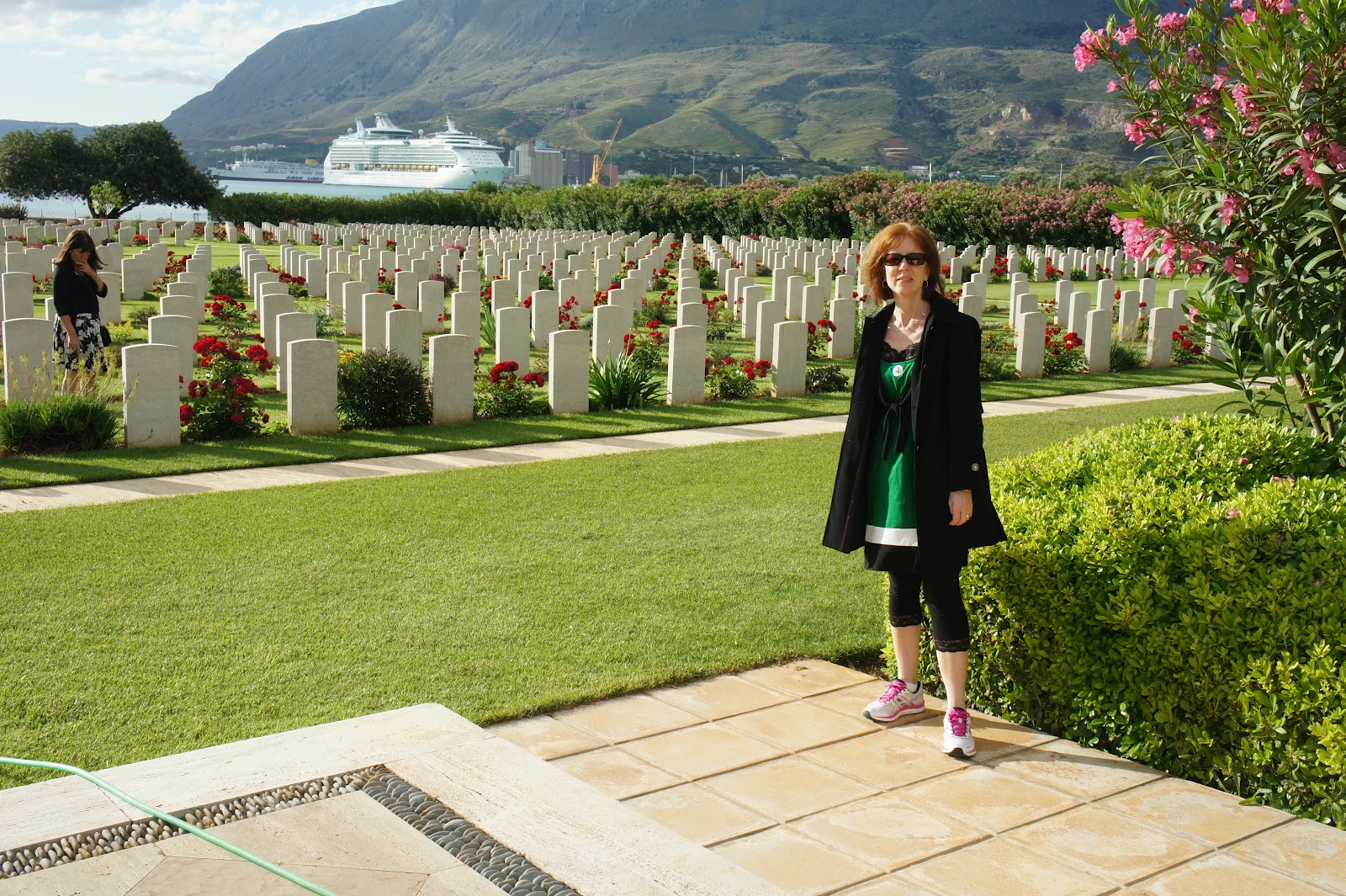
Friday we visited Chania, Crete. The tour we took in Crete visited a cemetery of the over 3,500 soldiers (largely British) that died attempting to repel the German invasion of the island during World War II. The cemetery was beautiful with rows of gravestones, beautiful flowers, and the harbor in the background. As is often the case, it made me appreciate yet again the sacrifices that so many have made. It was very humbling. We also visited a monastery run by five monks. It was not very old and was overrun by cats, supposedly 54 of them. It seemed that everywhere we went we would hear the mewling of kittens and find them hiding behind some flowers. The tour guide described to us the history of Crete from when its Minoan civilization was Europe’s first advanced one. From there, she went through all of the empires that ruled over Crete for at least 100 years. It was an impressive list of pretty much every major power in the Mediterranean over the last four millennia. The few years of German occupation didn’t make the list. We also visited the town of Chania and enjoyed walking through its market.

Saturday was another day at sea, a day to relax, play volleyball, read, and generally take it easy. I rode a stationary bike on the ship with my Garmin and recorded my favorite “ride.” Stationary indeed!  I averaged over 23 miles per hour as we passed by the island of Stromboli. 

Sunday, we flew home. Between the cruise and the flights, I was able to finish four books (1491, The Ascent of Money, Imagine, and Almost Amish). All in all, it was a wonderful trip. I have to admit, however, that I was pretty tired by the time we got home!  

Sunday, May 13, 2012

Two to the fifth years of marriage

May 17th is Susie’s and my two to the fifth (32nd) anniversary. That both seems like an eternity and a twinkling ago. At one level, I can barely remember not being married.  On another, it seems like just a mere moments ago that I walked down the aisle with my beautiful new bride. 

This picture pretty much sums up that day for me.  I am not very good at smiling in pictures. Sometimes, I seem to have a snarl or sneer for an expression. At others, I have some odd facial contortion that I think is me trying to make a smile, but failing miserably. In this picture, however, my smile is genuine.  And, big! I realized that I had just gotten away with it—a socially inept computer nerd (before that was all the rage) had managed to marry the most gorgeous and intelligent woman he had ever met. Whatever my flaws, I had chosen wisely—thirty-two years later she is still the most gorgeous and intelligent woman I have ever met.

I remember odd things from our wedding day. I remember playing tennis that morning with Susie’s brother, Tim. (For which she has still not quite forgiven me.) I remember how beautiful Susie’s smile was. I remember Susie’s granddad’s short sermon on the submissive role of the wife in front of a bunch of Columbia/Barnard women who did not disagree because he was so sweet while saying it. I remember our friends the Grizzles trying to sneak away from the wedding reception so there would be enough seats for folks who had shown up without sending RSVPs. I remember the bowl of flowers that was too large to sit on top of the wedding cake. I remember finding rice in all sorts of places that night. 

For all that the time has gone by so quickly, marriage is not always easy. Fortunately, both Susie and I are committed to it. We view love as something one does, not just feels. I believe that Susie is worth fighting for, worth sacrificing for. My job is to make her dreams come true. Sure, that is sappy, but I believe it and try to work toward that end.

As this picture from our vacation to Jamaica last year shows, when I’m with Susie, I still have the smile of a man who knows he has gotten away with something. Gotten away with having a wonderful life with a gorgeous and intelligent woman worth fighting for. I’m looking forward to the years leading up to our two to the sixth anniversary!

Sunday, May 6, 2012

3 State 3 Mountains Challenge

I’ve mentioned my love/obsession with cycling before in my blog. I also enjoy being able to set new goals and challenges for myself. On Saturday my cycling buddy (John) and I went to Chattanooga to ride in the 3 State 3 Mountain Challenge. The ride is a fairly large 100-mile long bike ride that, as the name states, covers three mountains (Aetna Mountain, Sand Mountain, and Lookout Mountain) in three states (Tennessee, Alabama, and Georgia). My guess is that there were at least 500 cyclists participating. It was a very well organized ride with rest stops along the way (at 24, 53, 82, and 85 miles). Those rest stops are essential as they provide an opportunity to get some food and water. On a long ride like this one, it is important to get in enough simple carbs (sugar) to keep up with the amount you burn while riding. 
 

Part of the challenge of the ride was just getting there as it was in Chattanooga which is a bit over seven hours from where we live in Raleigh. In the space of 36 hours, we drove almost 900 miles and pedaled 100. Suffice to say, I’m fairly tired and cannot vouch for the contents of this blog entry! 

As always, I used my Garmin Edge 500 to gather an extensive array of data from my ride. If you look at that page, you can see a lot of information. On the upper right is a map of the ride. The Edge 500 includes a GPS which is constantly monitoring its location. When I upload that data to the Garmin Web site, it can draw the route on the map based on those data points. The Edge 500 uses a wireless protocol (ANT+) to communicate with a heart-rate monitor I wear around my chest, a detector on my rear wheel that also measures speed in case the GPS has trouble contacting the satellites, and a detector on my pedal that measures how fast I’m pedaling (cadence). Down the left side of the page is a bunch of summary information. Beneath the map you can see graphs of my speed, elevation, heart rate, cadence, and the temperature. If you click on the "Player" button above the map, you can replay the ride and watch my heart rate go up (and my speed go down) as I climb the three mountains. 

There are a few interesting things in the data I’ll point out to give you an better idea what the ride was like. The maximum speed of 97.6 mph is just plain wrong. For some reason, the Edge 500 occasionally gets spurious readings. My maximum speed was in the low- to mid-40s. It took a lot of braking on the downhill sections to keep it that slow. In fact my hands got sore from braking. You can’t brake continuously lest the wheels lock up or the brakes overheat. So, you have to do things like braking for two seconds followed by coasting for two seconds. The downhill sections on a ride like this can be harrowing and an amazing adrenaline rush. At one point the ride organizers painted on the street, “Slow Caution Dangerous Curve.” That was enough to make me brake a bit harder. The set of ambulances on the hairpin turn waiting for someone to not take the warning seriously made me brake even harder still. 

If you look at the temperature plot, you can see that it got fairly hot at a few points on the ride. Sadly, one of those points was on the toughest hill, Lookout Mountain. There was little shade on that hill and after 85 miles of riding, it was especially hard. (Once I climbed it, the need for rest stops 3 miles apart—at the top and bottom of the hill—became apparent!) If you look carefully at my speed at about 5 hours and 15 minutes into the ride, you will see that it drops to under 3 mph. At that point, the grade was 18% and I could no longer pedal. I had to get off and walk for the final .3 miles of the hill. Lots of folks were walking. Behind me I heard someone fall down and saw them lying on the ground. Apparently, the bike was going so slowly that the person tipped over. 

As the slow speeds show, the final 15 miles after that point were fairly miserable. I was totally exhausted. John was a good friend and rode those miles with me. We got showers, ate some mediocre lasagna, and drove 7.5 hours home. I arrived home exhausted, but feeling good. 

The obvious question is, why do I do this? Even a couple of good friends that I cycle with called me crazy when I showed them the data from the ride. Why I cycle is a different question and I discussed that in my previous cycling blog post. Why do I push to do hard rides like this one when from most perspectives it is not fun? I don’t have a simple answer. Maybe I like having cycling friends think I’m crazy. More importantly, I think it something about setting tough but possible goals and accomplishing them (or at least getting within .3 miles of accomplishing them). If there is no risk of failure, then what is the challenge? I don’t really know for sure. But, I’m looking for the next challenge. Maybe the Mountains to Coast ride across NC in the Fall? 

Monday, April 30, 2012

Quick book reviews

In my blog last week I talked a lot about my view of books and reading.  This week, I wanted to spend some time on some books themselves.  Here are some short reviews of books I finished over the last month or two.  As I mentioned last week, I try to put my single-paragraph book reviews on Library Thing as a way of helping me remember what I've read.  Worth noting, I read all of these as Kindle ebooks.  

These reviews use a scale of 5 stars.  I am a tough grader--the only book that I’ve given 5 stars to in the years I’ve been grading books is Crazy Love: Overwhelmed by a Relentless God by Francis Chan.  Obviously, that one is worth reading!  

The Psychopath Test: A Journey Through the Madness Industry by Jon Ronson (3.5 stars)

This was one of the books I purchased based on his talk at TED this year (which is not yet available on www.ted.com).  You may have heard about one of Ronson’s previous books, The Men Who Stare at Goats.  He seems to like examining people outside of the ordinary.  The Psychopath Test is an enjoyable read that definitely makes you question psychology.  I would recommend this book if you are interested in the meaning of psychosis or wonder about what it really means to be psychotic.

Real Marriage: The Truth about Sex, Friendship, & Life Together by Mark & Grace Driscoll (3.5 stars)

The Driscolls' book does not include much that I have not read before, but it does have lots of good stuff to say and does so in a brisk, easy-to-read manner.  The main thing that differentiates this book from other Christian marriage books is that the authors do a good job of openly discussing topics that other books shy away from.  Part of that is Grace Driscoll's life story including sexual abuse.  For many women (and men) this is an important dynamic that Christian marriage books are less willing to confront.  I recommend this book to anyone looking to improve their marriage or tackle issues in their marriage. 

No Going Back by Mark L. Van Name (4.0 stars assuming you read the previous Jon and Lobo books)

This is the latest entry in the John and Lobo series.  If you are a fan, you definitely need to read this one as there are plenty of revelations about the characters in the continuing saga.  It is a book that made me fall prey to just-one-more-chapter syndrome.  To me, it was a more fun read than the last couple of the books in the series.  Please note, I claim no objectivity whatsoever in this review as the author has been my business partner and friend for over 25 years.

In the Plex: How Google Thinks, Works, and Shapes Our Lives by Steven Levy (3.0 stars)

Steven Levy is one of the leading chroniclers of the times and culture of the computer/Internet era.  He had unprecedented access to Google and its employees during his research for this book.  His portrayal is generally favorable, but far from fawning.  I liked the book since it gave me new pieces of data about the industry I in which I live and work.  As such, the book was fun for me, but probably will not be of great interest to folks outside the computer industry. 

Destiny of the Republic: A Tale of Madness, Medicine and the Murder of a President by Candice Millard (4.0 stars)

James Garfield is a president about whom I knew next to nothing.  After reading this book, I wanted to know more, much more.  He was a president who was strong in his Christian faith and very much a man of the people.  The book weaves together the strands of Garfield and his times, his crazy assassin, and the state of the technology of medicine.  Suffice to say, you did not want to get shot in that day and age.  All-in-all, this was a fascinating piece of historical writing that I would recommend to anyone who likes history.

I also wanted to mention one lingering thought from my last blog.   I think the issue of how to show off books is one that the ebooks publishers need to tackle.  Book lovers like to show off their bookcases or browse through them.  There is a real need for a better Kindle app.  There currently is no good way to categorize books in the app.  I have over 100 books and looking through them is annoying.  If I open a book for any reason, it goes to the front of my reading list.  Being able to put the books in shelves with names like, “Finished reading” or “Economics,” would be very useful.  I would also love a sort of slideshow app that would allow me to have a screen on the wall that would show book covers and brief descriptions.  I could put an iPad (or a bigger screen version of one) on the wall and show off/browse my ebookshelves that way.  I could also even allow others to browse my ebooks remotely.  I have a few friends whose ebookshelves I would love to browse.

Here is some free advice for Amazon—buy Library Thing and incorporate its functionality (and my suggestions above) into the Kindle apps.  If they did this (and put a purchase button on it), I’m convinced it would sell more books. 


Sunday, April 22, 2012

Bibliophilia or bibliomania?

I love books.  There, I’ve said it--more or less in public.  The question is whether I suffer from bibliophilia or bibliomania.  The former is just a love of books while the latter is a book obsession that leads to the destruction of relationships and health.  I've been aware of my problem for awhile and I’m taking steps to keep on the right side of the bibliophilia/bibliomania line.  

One way of knowing I have a book problem is that I never have enough bookshelves.  I’ve included a couple pictures of my main built-in bookshelves.  I have other smaller ones scattered throughout the house as well as some piles and I'm looking to build another wall of bookshelves.  Even those will not be enough to house all of the books I have boxed up in the basement.  Though I have friends with even more books and bookshelves (ahem, Mark), I really do have a problem.  

Part of my solution has been to switch to ebooks.   I love the experience of reading a real book, of turning the pages.  Switching to ebooks was hard.  On the other hand, ebooks give me the benefits of always having a pile of books with me when I travel, of not having to keep building more bookshelves, and of being better environmentally. 

Another book problem I have is that I often forget what I’ve read.  To counteract that, I started a few years ago to force myself to write at least a paragraph about each book when I finish it.  

I used the Library Thing Web site.  It is a site for book lovers that allows you to catalog your books, give them ratings, and review them.  The ratings and reviews are then available for others to see and use in evaluating what books to read.  I was pretty good about entering my books there for a couple years.  One unfortunate consequence of switching to ebooks is that I stopped entering my reviews and ratings over a year ago.  The reason?  My system relied on a pile of books to remind me.  With ebooks, of course, there is no pile.  So, I've switched to an electronic mechanism and also will start putting some of my reviews in my blog. 

To give you some idea about how I read books, here are the books I currently am reading.  My definition of “currently reading” is that I have read at least one chapter of the book in the last two weeks.  This list is directly from my Kindle (well, the Kindle app on my iPad): 
  • Imagine: How Creativity Works by Jonah Lehrer
  • The Ascent of Money: A Financial History of the World by Niall Ferguson
  • Everyday Missions: How Ordinary People Change the World by Leroy Barber
  • Almost Amish by Nancy Sleeth 
  • The No-Drop Zone: Everything You Need to Know about the Peloton, Your Gear, and Riding Strong by Patrick Brady
  • Bonhoeffer: Pastor, Martyr, Prophet, Spy by Eric Metaxas
  • Alone Together: Why We Expect More from Technology and Less from Each Other by Sherry Turkle
  • The Optimism Bias: A Tour of the Irrationally Positive Brain by Tali Sharot
  • 1491 (Second Edition): New Revelations of the Americas before Columbus by Charles C. Mann
  • Quiet by Susan Cain
  • Narcissism Epidemic by Jean M. Twenge
  • It Happened on the Way to War by Rye Barcott
  • The Philosophical Breakfast Club: Four Remarkable Friends Who Transformed Science by Laura J. Snyder
Putting that list up (and forcing myself to not edit it) was an interesting exercise.  Showing what I’m reading is rather revealing.  At the same time, I realize it is also a way to show off.  That is another part of the reason I have moved to ebooks—I came to understand that my love of bookshelves and books was, at least partially, a way to show off.  That is one of the areas that as a Christian I need to move beyond.  

One thing to note about the list above is the lack of any fiction on that list.  That was the first step which I took years ago to curb my bibliomania.  If I read fiction, I can’t stop.  I will give up sleep and pretty much anything else until I finish the book.  My solution has been to only allow myself a few fiction books a year.  I’ve read Mark Van Name’s Jon and Lobo books over the last few years.  In some years, that was the only fiction I read.  This year, I permitted myself to read the Hunger Games series.  A few years ago, I read the Harry Potter books.  In each case, the better word would be devoured.  

All kidding about bibliomania aside, is this really a problem I need to solve?  For me, the answer is yes.  I see any part of my life that is out of control or all-consuming as something that competes with putting Christ first in my life.  Obviously, books and reading are not the only place I need to work on.  But, it is a place to start.   

I finished this blog entry early.  Think it would be OK if I got in some reading before going to sleep?  On my Kindle, of course! 

Sunday, April 15, 2012

My dad

About two years ago, on April 18, 2010, my dad died.  In those two years, some memories about him have faded and others have become sharper.  

It is impossible to even come close to adequately describing a life in a blog entry, but I plan to try.  As I assume most of the folks reading this blog know me at least somewhat, I’m hoping that I can give you some sense of who my dad was by telling you about him in terms of some of our similarities and how he influenced my life.  Maybe you'll be able to see a bit of him when you see me.  The picture below would have been from late 1959 when I was almost 2 years old on my first cycle.  He would have been 30.  

While I don’t think he looks much like me, we shared a number of physical characteristics.  We were about the same size—six feet tall and on the wrong side of 200 pounds.  All my memories of him were with lots of gray hair, like mine, but slightly curly.

We shared a name.  He was William Baird Catchings, Jr.  He hated the junior.  His dad was called Bill and he was called Billy.  So, of course, I was called Barry.  No, I don't know exactly why.  Suffice to say, only my mom and brother still call me Barry.  

My dad was born in Raleigh, on Halloween 1929, just a few days after the stock market crash that began the Great Depression.  As a young boy, he lived downtown on W. Johnson Street near Saint Mary's.  His dad, my grandfather was an engineer.  They lived well.  My dad likes to tell me that when the season's new clothes would come out, Belk's would come to the house to show them to his mom.  But, like many others, they lost everything in the Depression.  They had to move to Cary.  It is pretty funny that about 50 years later I moved to Cary, one block from where he lived in the mid-1930s.

My grandfather worked on building airports, and especially in the late-1930s and 1940s, that meant moving a lot.  Even though my dad was born in Raleigh, he lived many different places and did not really have a place with strong roots growing up.  He eventually ended up in NJ where he met and married my mom.  They lived there for over 25 years before moving to Manning, SC where they lived for almost 30 years.    

My dad was careful with money.  He often lectured me about the dangers of credit cards.  He claimed they were the reason he and his parents had to move to Cary.  I’m sure that his views on money had some influence on my cautious attitude toward investing and saving.  

Even though he was very careful with money, my dad became an entrepreneur.  He worked for many years as an accountant, but his passion was antiques.  When he was laid off as an accountant in the 1970s, he chose to make antiques his business.  The name of the business was The Silver Porringer.  He and my mom traveled up and down the East Coast to antique shows selling the silver and other antiques they bought at garage sales, auctions, and from other antique dealers.  Looking back, I respect the courage it took to start a business with two kids approaching college age.  

To this day, I prefer eating food off of silverware and even have some in my drawer at work for eating lunch.  (Only silver plate in case anyone was wondering...)   I still can recognize some silver patterns when I see them.  

My dad loved to travel and I do as well.  He took us to Europe when I was in seventh grade.  As kids, we drove over much of the eastern US on vacations.  Of course, he was always looking for antique shops.  Jamey and I would try to see signs for them well in advance and then point out cows or something interesting on the other side of the road so he would not see the signs.  

As some of you may have noticed, I am prone to kidding people.  So was my dad.  When my kids were young, they went to spend a week with my parents.  My parents wanted to know what foods they like to eat.  We said that for vegetables, the only one we knew they all liked was corn.  So, my dad made sure they had corn at pretty much every meal.  He would gleefully sing to them, “Corn, corn, corn, corn!”  For years afterwards, every Christmas each of them would receive a wrapped can of corn from my dad.  He did have a little trouble knowing when to stop kidding!  

My dad was a man of his generation.  He tended to be reserved and not show much affection (at least until he got older).  He said, and at least partially believed, “Children should be seen and not heard.”   But, whatever his faults, he was a good father.  Much of who I am today is due to my dad.

I am proud to be William Baird Catchings, III.   

Sunday, April 8, 2012

A frog from my past

I spent this past weekend in NYC with Susie.  We walked around Manhattan, wandered through museums, ate too much, and generally had a good time.  The primary reason for the trip was the opportunity on Friday to participate in an oral history panel discussion that the Computer History Museum conducted.  The discussion was about the Kermit file transfer protocol.  A little over 30 years ago, I worked at Columbia University on the original versions of Kermit.   The picture below is from 1981 and shows a much younger me at work in front of PDP-11 and DEC-20 manuals. As you can see, I've always dressed well at work!

Kermit is a protocol and set of programs for moving files between computers before the Internet. In the early years, that meant dial-up connections as slow as 300bps.  (Note the lack of K, M, or G before the bits per second!)  We designed Kermit to work between a wide variety of computers—from IBM mainframes to DEC minicomputers to CP/M microcomputers. To make them able to work together, we designed the protocol to accommodate the lowest common denominator and assume as little as possible. The Kermit programs on a pair of computers negotiated what was possible at the beginning of a file transfer session and were able to work, often in situations where nothing else would. 

I worked on Kermit from its inception in 1981 until I left Columbia and moved to North Carolina in 1985. During that time, I developed the early versions of the Kermit protocol with my boss at Columbia (Frank da Cruz), wrote a number of the original versions of Kermit, co-authored an article for Byte magazine with Frank, and spoke at conventions about Kermit.  Frank continued working on Kermit at Columbia until 2011.  During that time, Kermit became a program used around the world and even in outer space.  Frank even traveled to the Soviet Union in 1989 to speak about Kermit and how to improve it. 

Frank was on Friday's panel discussion along with me and another person who worked on the project long after I was gone.  It was very interesting to discuss the work I had done so many years ago and to in turn hear stories about Frank, Columbia, and Kermit that were new to me.  

I came away from the experience with a couple thoughts.  First, I am proud to have been a part of Kermit.  I believed in the effort and was an enthusiastic (if naive) supporter of the idea of creating software that could be freely used and help as many people as possible at the beginning of the PC revolution.  

At least as importantly, I am once again convinced of how God blessed me in my work during that time, and the years since.  Not only have I had opportunities to work at a number of interesting projects and jobs, but I have been compensated well along the way.  Even better, I have had the support wonderful wife for almost 32 years, and three great kids as well.  I have much to be thankful for.