Sunday, June 24, 2012

Proud Papa

Ethan, my younger grandson, just turned 2 years old. Susie and I were out of town, so we missed his birthday party. My daughter-in-law Emily always has themed parties for the boys. As this picture shows, the theme this birthday was baseball. My other grandson, Tommy (3 years old), is on the left and Ethan is on the right. It would be very hard to be anything but a proud grandparent with two grandsons that cute.

Part of the reason we were out of town was that while Susie was at a medical conference in Philadelphia, I was able to spend Saturday in Milltown, NJ where I grew up. I went to the graveyard where my dad is buried and took a picture of the gravestone to show my mom who probably will never have the opportunity to visit it.

My dad’s grave is in my mom’s family plot. Among other relatives, my grandfather is buried there. He was always my favorite relative. I called him Gramps. I remember lots of fun times with him. He taught me to play Pinochle and other card games. He used to tell me stories he made up and silly rhymes like, “Adam and Eve and Pinchme went down to the river to bathe. Adam and Eve got drowned, who do you think got saved?” Of course, the correct answer of Pinchme resulted in getting pinched.

My dad was not at all into anything athletic. I don’t remember him ever throwing me a ball. Gramps would. He would play kickball with me or whatever sport I was interested in. He traveled extensively and told great tales of his travels. To me, he was a larger-than-life character that I loved.

I found out as I got older that he really was quite a character. He had no middle name, but always referred to himself as James Vernon Cockerill (note the gravestone). As best we can figure, he borrowed the name from Vernon Castle.  I still have some pieces of wood that he claimed were from the crash of Castle’s airplane. Gramps claimed he served during World War I at the airfield in Texas where the crash happened. I use the word claim because separating truth from reality with him was hard. 

He got in trouble one time while visiting the island of Guernsey as he claimed to be going to visit the queen. They take the queen rather seriously over there and suspected him of who knows what. The friend he was visiting in Guernsey never spoke to my grandfather again after the episode. 

Gramps wore outrageous clothes and was vain enough that he would never admit how old he was. His grave only has the date of his death, not of his birth. He died in his late 80s while rehearsing for a play at the retirement community where he lived. 

Whatever his flaws, he was Gramps. By contrast, my dad’s parents were Grandmother and Grandfather. There were very much of the children-should-be-seen-and-not-heard school. I remember little about them other than that they were scary and smelled funny. 

It should be pretty obvious which grandparent I want to be like. Not coincidentally, I always wanted to be called Gramps. Tommy, however, calls me Papa or Papa Bill. In truth, he could call me Poopyhead and I would be just fine with it. After all, he is my grandson. Look at that mischievous grin from his train-themed 3-year-old birthday party. How could I not be smitten? So too with Ethan’s crooked smile. 

I want to be a part of their lives. I want to be that fun grandfather that is willing to do crazy things with them. I look forward to the day when I can go bike riding with them, help them build amazing Lego creations, teach them to play Pinochle or to post up in basketball, or join them in whatever they want to do. For now, I will make funny faces at them, wrestle with them, and maybe even trick them into saying, “Pinch me!”

Monday, June 18, 2012

Privacy is so 20th Century

One consequence of writing a blog is that people read it. (OK, not a lot of people.) I wrote about my trip to Bolivia a while back only to realize that one of the teenagers I mentioned may have read it. After quickly making sure what I said was OK, I starting thinking about the loss of privacy due to technology. I’m aware of how much data on me corporations have. While I try to minimize that, it doesn’t bother me too much that they know what I like to buy or do. I'm more concerned with what individuals know about me.

The younger generations seem to care much less about privacy. After all, look what people will say (and show) on Facebook and Twitter. I avoid saying much on Facebook and avoid Twitter entirely. But, now I am writing a blog. I worry about posting blog entries when I’m out of town. Why let the world know I’m cruising in the Mediterranean until I’m safely at home? Is that paranoia or prudence? How can I even be concerned about privacy when I write about myself? Such are the privacy questions we all face.

I came up with the title of this blog to indicate that privacy may be a concept whose time is passing. While doing a little research on privacy, I started to doubt that privacy was something we always had and just recently starting to lose. Instead, privacy may have been largely a 20th Century concept. 

For all that we consider privacy an American right, it is either vague or non-existent in the Constitution. The Bill of Rights protects us from unreasonable search and seizure which some interpret to include privacy. That is hardly a strong indication of a right to privacy. Further, privacy may well not have been what the framers had in mind at all. I’m not aware of the Bible really talking about privacy, though there are some negative references to things done in secret. 

My feeling (admittedly, not extensively researched) is that privacy would have been a fairly foreign concept to most people in most times in history. Most people did not have the luxury of private rooms and spaces to make privacy as easy as it is today. Small communities are generally thought of as places where everyone knows everyone's business.

Why do we value privacy? It seems that privacy should not be so important if we don’t have things to hide. I wonder if the ability to hide things encourages bad behavior. I'd love to know your thoughts or if you are aware of any good resource materials on this topic.

Regardless, I think that privacy is fading in the 21st Century. Maybe the lack of privacy is a new phenomenon or maybe that is a return to the way things used to be. For the moment, I plan to be more private than most, get used to privacy being less than it was when I was growing up, and study more about what level of privacy we ought to have according to the Bible and the Constitution.

I guess I should be grateful that not many folks will read this!
 

Sunday, June 10, 2012

Death sucks

On Saturday I went cycling with a couple of good friends, John and Jay. The weather was beautiful and the ride, very enjoyable. We were riding in the gentle rolling hills and farmland between McGee’s Crossroads and Bentonville. We rode by fields of young tobacco, corn, and other crops I could not identify. We saw Enoch’s Winery and Bistro and wondered about a bistro in the middle of farm country. We passed by churches and schools. We pedaled by family cemeteries, abandoned buildings, and odd stores in old buildings. We did not talk much, so there was plenty of time for thinking. When we stopped at a small grocery store at the halfway point, John mentioned he had been thinking about what color to paint his old bike. Then he asked me what I had been thinking.

It was not meant to be a deep question, but my response was the truthful one, or at least part of the truth. I said I was thinking about the inerrancy of Scripture. I didn’t go on to mention that I had also been thinking about the use of metaphor in the Bible. And, about death. There was no need to mention those thoughts as I had already ground the conversation to a halt. We somewhat awkwardly transitioned back to the new color for John’s old pink/magenta bike. 

Back on our bikes, I could not shake the thought that there seems to be way too much death lately. Jay’s dad died a week ago. An acquaintance (about my age) from my church’s worship team died suddenly, also in the last week. I attended viewings/wakes for both of them. My pastor’s mom died a month ago. My friend and business partner’s mom died earlier in the year. It seems like lots of folks are dying. That is probably just a consequence of getting older. Regardless, I don’t like it. 

Like many in modern society, I thought death was distant. Until a few years ago, I had seldom attended a funeral. In the first 40 years of my life, I only remember attending one, that of a teenage sister of a good friend of mine. Funerals seemed to be rare rituals presided over by professionals. Even when I did attend one, it seemed to further distance me from death. I saw but brief glimpses of the dead at viewings. Cemeteries tend to be in out-of-the-way places. Places we don’t visit. My family’s plot is in NJ, where my dad is buried. I think I have been there once in the last 30 years.
Things were different in earlier times. Death was all around.  Children commonly died. The bodies of the dead were tended to by families. Funerals were common occurrences that involved whole communities. Cemeteries were important parts of a town or city.

Today, we use euphemisms to talk about death, saying things like, “he passed” or “the dearly departed.” We may say something like, “she's in a better place.”  These phrases hide the real truth—death is wrong. It is not how things were meant to be. Despite our attempts to keep death in its place, death is still something that happens to everyone.
Paul in I Corinthians 15 talks about the hope that we as Christians share in Christ’s resurrection. After talking about that triumph, in verse 26 Paul says, “The last enemy that will be abolished is death.” Death is indeed an enemy. Jesus weeps at Lazarus' death (John 11:35). The night before His crucifixion, and later during His final moments, Jesus does not use such pleasant euphemisms.

Later in the same chapter of I Corinthians (verse 55), Paul says “O death, where is your victory? O death, where is your sting?” Though often quoted, those words are for the future when death has been conquered.

Pondering my own mortality, I rejoice in the future promise of those words.  I don’t fear death, but I do see it for what it is—the enemy, a horrible consequence of the Fall. I look forward to its ultimate defeat. 

In the meantime, death sucks.

Sunday, June 3, 2012

Quick book reviews (#2)

One of the nice consequences of our recent Mediterranean cruise is that I got to read a decent amount. I’ve done my usual brief reviews below. These reviews use a scale of 5 stars based on Library Thing. I am generally a tough grader, but these books were all very good. I read all of them on a Kindle or with the Kindle app on my iPad or iPhone. 

Almost Amish: One Woman’s Quest for a Slower, Simpler, More Sustainable Life by Nancy Sleeth (4.5 star)

Last year I read, and was very impressed with, The Gospel According to the Earth: Why the Good Book Is a Green Book by Matthew Sleeth.  It does a wonderful job of giving both practical and scriptural basis for the book’s subtitle. His wife Nancy’s book covers similar ground, but from a different perspective. Again, the book’s subtitle does an excellent job of describing the book. The basic premise is that the Amish way of life is an instructive one. Rather than just accepting every technology, wanting every possible thing, and living life on the terms decided by the media and the world, we need to choose which of each of this things to include in our life. The Amish life is a much simpler life, though arguably richer than our lives. As the title implies, Sleeth thinks we don’t need to be Amish, but instead to apply those principles. She gives examples that show how she and her husband have attempted to apply Amish principles to how they live their lives. I plan to be seriously thinking about how to apply some of these concepts to my life. I think I’ll start with an easy one and give any clothes I’ve not worn in over a year to Goodwill.  I would recommend this book to anyone who feels the stress and strain of modern life. 

1491 (Second Edition): New Revelations of the Americas before Columbus by Charles C. Mann (4.0 stars)

The basic question this book tries to answer is what were the Americas like before Columbus and the Europeans arrived. The book pulls together lots of resources to argue persuasively that the year 1491 is not at all like what we usually imagine. Mann contends that the population of the Americas was vastly larger than we once thought and that the Indians were not just hunter/gatherers living in harmony with nature. Instead, they transformed their environment on a massive scale. Rather than just farming vegetables, they farmed trees and entire ecosystems. He contends that much of the Amazon rainforest was actually created by civilizations we know very little about since the climate and geography mean that traces of them are hard to detect. The reason that we think of the native population of the Americas so differently is because European illnesses (and other external factors like weather changes) caused a rapid and massive population collapse, potentially over 95% of the population in 1491 was gone in the next century or so. For example, when the Pilgrims landed, there were few Indians there. The Pilgrims were able to use lands that had been farmed by Indians when they were more numerous. His conclusions are fairly controversial, but he makes them very well. If you are at all interested in American history or anthropology, this is well worth your time to read.

Imagine: How Creativity Works by Jonah Lehrer (3.5 stars)

This book attempts to look at the creative process. For me, I read this largely through the prism of what I and my company should do to foster creativity in our workplace. Lehrer looks at creativity through individual examples, like Bob Dylan, as well as the latest in neuroscience and psychology to try and understand the creative process. One of the big takeaways for me is the importance of allowing the brain time to wander. This is related to the phenomenon of having great ideas in the shower. As the author himself would probably agree, I need to let the ideas in the book percolate a bit before deciding what to do with them. I would recommend this book to anyone involved in work that requires creativity and who is willing to think about the best way to maximize creativity. Arguably, pretty much everyone and job would be well served by more creativity! 

The Ascent of Money: A Financial History of the World by Nial Ferguson (3.5 stars)

This book is a fascinating look at the development of money from shells to coins to paper money to today’s complex financial instruments such as the famed credit default swaps at the center of the recent financial meltdown. All of these are levels of abstraction that allow for easier transactions. Without them, we would be trying to pay for our iPhones with carts full of grain. What Ferguson does is walk through the development of these financial innovations and show how they happened, how they work, and the impact each had on history. I enjoyed the book, but it was at times a bit of a chore to read. If you like history and would like to learn more about finance, this book is worth reading.

As to what I’m currently reading, the six I’ve read at least a chapter of in the last couple of weeks include It Happened on the Way to War, The Intolerance of Tolerance, The Philosophical Breakfast Club, Everyday Missions, The Optimism Bias, and The Narcissism Epidemic. Yes, I do read an odd selection of books! 

Monday, May 28, 2012

Anniversary cruise travelogue

To celebrate our 32nd anniversary, Susie and I went on a Mediterranean cruise. This blog entry is my attempt to give a bit of a flavor for our trip. I apologize for how long it took me to write this entry, but it took some work to distill a week and almost 1,500 photos down to something anyone might be willing to read! I am trying to figure out the best place to put the photos (under 200 now) given that my preferred photo place (Kodak Gallery) is shutting down soon. 

We flew to Rome on Friday (May 11) and arrived on Saturday. As we had been to Rome before, our main goal was not to see anything in particular, but rather to try and stay awake until at least 9:00pm to get acclimated to the time zone (off by six hours). Our hotel (La Griffe) was in the middle of everything, so we spent much of the day walking to typical sights like the Trevi Fountain (which was mobbed and looked sort of like a mosh pit with some stone horses and water in the middle). We saw lots of churches and fountains as well as mobs of people including some dressed as Roman soldiers and others painted silver like statues. At the Coliseum we encountered a parade of communist protestors. They were doing lots of chanting and singing of slogans in Italian. It added a bit of festivity to our walk around the building.

On Sunday we attended an Episcopal church with services in English right near our hotel. The church, of course, was beautiful and was probably older than anything in our area. We then took a shuttle to our cruise ship. We managed to get on to the ship fairly uneventfully. I had hoped to get a table for two for dinner, but that did not happen. As I feared, we had to meet people. As I never would have guessed, we got along very well with the couple (Donna and Mark). We enjoyed spending dinner with them every night as well as doing a number of things on board the ship. As is often the case, I was wrong! They taught us a song to sing when that happens. The third couple (from Budapest) showed up one evening, but never again. I think they decided to not join our tight-knit foursome.

The first stop was on Monday in Messina, Sicily. I confess that my European geography is fairly weak. I did not realize that the distance from Sicily to Italy was only three miles. We took a tour that went to Mount Aetna, an active volcano. There was no molten lava to see, but as the bus went up the mountain, more and more of it was black from previous eruptions. The tour guide would say things like, “Over there is where the 2002 eruption happened and right up ahead is the end of the lava flow from 1998.” It was all rather surreal and hard to comprehend what it would be like to live in the shadow of a volcano. We also visited a beautiful sea coast town, Taormina. We walked down its main street, looked down or up the many quaint side streets, stepped into a number of churches, and enjoyed a bite to eat at an outdoor cafĂ© while watching people walk by. It was a wonderful day.

We spent Tuesday at sea. That meant we read, Susie climbed the rock wall, we went shopping, and I played in a volleyball tournament. In the evening we dressed up for one of the formal dinners. It was a nice relaxing day that let us get some much needed rest.
On Wednesday we docked near Ephesus, Turkey. For me, I think that stop was the highlight of the trip. The ruins at Ephesus were amazing. Not amazing in the way that the Coliseum is. The Coliseum is imposing enough that you come away wondering how was it possible that people could build something that big almost 2,000 years ago. But, the Coliseum is in the middle of a large city and it is hard to picture what it must have been like in its day.  Instead, Ephesus consists only of ruins and has enough intact or restored buildings that you can get a general sense what it was like. We walked past the bazaar, strolled down the crowded main street, walked into the library, viewed what the tour guide described as the gentlemen’s club, and saw the 24,000-seat arena. As the picture shows, none of the buildings was intact, but it gave a real sense of what it would have been like when Paul was there. We also visited a place where Jesus’ mother Mary supposedly lived for a few years, the ruins of a church where the Apostle John is purported to be buried, and a demonstration of Turkish rug making. 

On Thursday, our 32nd anniversary, we visited Athens, Greece. We had been there 28 years ago when Becky was two years old and Susie was pregnant with Nathan. One of my favorite memories of that visit was Becky sitting amongst small pieces of the stone from Parthenon saying, “Fee-fi-fo-fum, I smell the blood of an Englishman!” Back in the present, we took a tour that went to the Acropolis and some other sites in the city. The Acropolis was the obvious highlight. The somewhat intact buildings there, including the Parthenon, make a real impact. The impressive structures were largely built around 2,500 years ago. Much of the site, however, is being worked on to try and restore it. Part of that means taking down earlier (incorrect) attempts to reconstruct the buildings. There is scaffolding on many of the buildings which detracts a bit. Regardless, the buildings are quite amazing. As we were visiting, the Olympic torch was there--about to begin its journey to London for the games later this summer. While leaving the Acropolis, we somehow lost our tour group. After a few anxious moments, we were able to find another tour group from our ship and finished up with them (and their much better tour guide). Back on the ship, we had a great dinner including an anniversary surprise arranged by our new friends. 

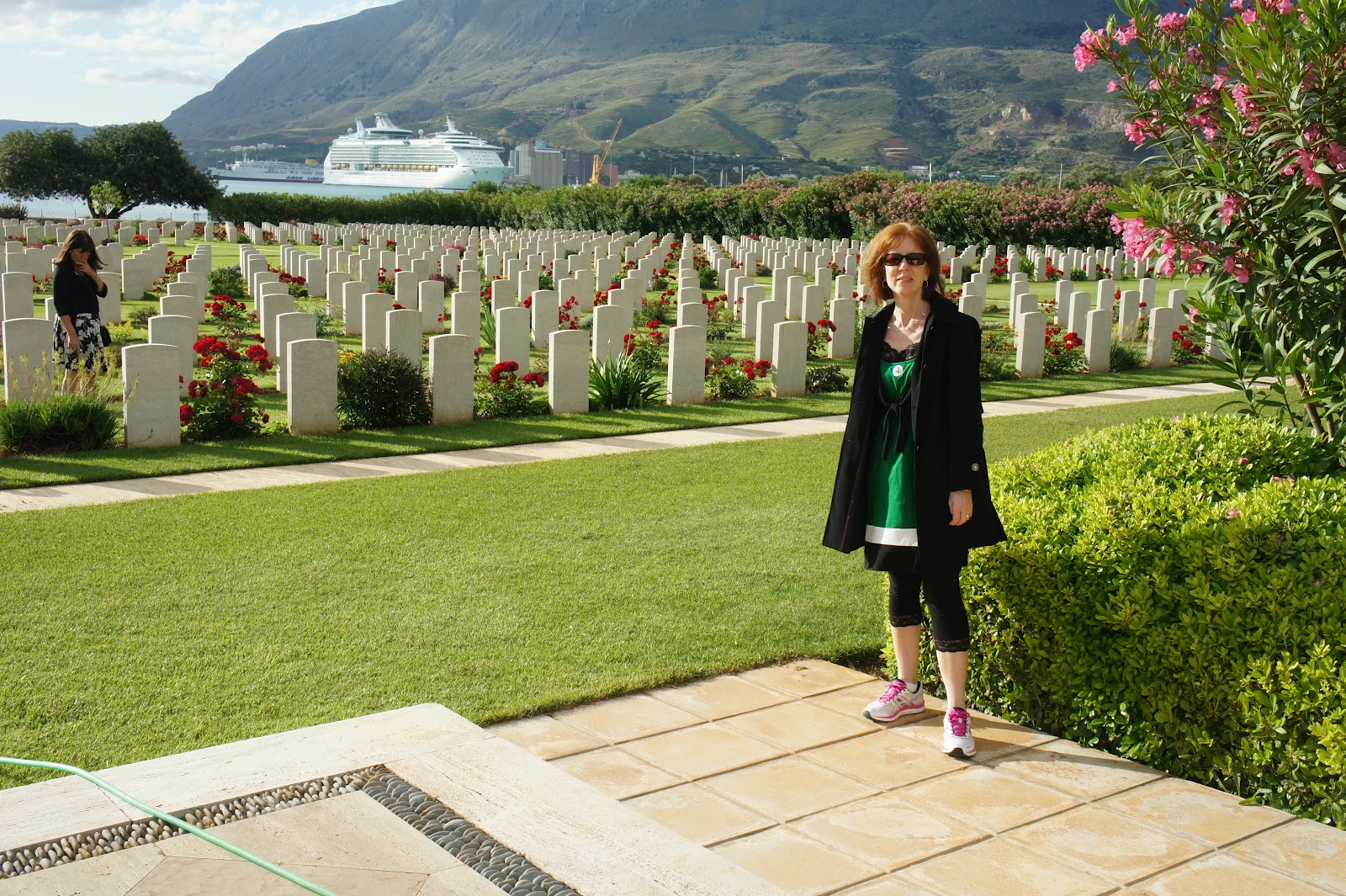
Friday we visited Chania, Crete. The tour we took in Crete visited a cemetery of the over 3,500 soldiers (largely British) that died attempting to repel the German invasion of the island during World War II. The cemetery was beautiful with rows of gravestones, beautiful flowers, and the harbor in the background. As is often the case, it made me appreciate yet again the sacrifices that so many have made. It was very humbling. We also visited a monastery run by five monks. It was not very old and was overrun by cats, supposedly 54 of them. It seemed that everywhere we went we would hear the mewling of kittens and find them hiding behind some flowers. The tour guide described to us the history of Crete from when its Minoan civilization was Europe’s first advanced one. From there, she went through all of the empires that ruled over Crete for at least 100 years. It was an impressive list of pretty much every major power in the Mediterranean over the last four millennia. The few years of German occupation didn’t make the list. We also visited the town of Chania and enjoyed walking through its market.

Saturday was another day at sea, a day to relax, play volleyball, read, and generally take it easy. I rode a stationary bike on the ship with my Garmin and recorded my favorite “ride.” Stationary indeed!  I averaged over 23 miles per hour as we passed by the island of Stromboli. 

Sunday, we flew home. Between the cruise and the flights, I was able to finish four books (1491, The Ascent of Money, Imagine, and Almost Amish). All in all, it was a wonderful trip. I have to admit, however, that I was pretty tired by the time we got home!  

Sunday, May 13, 2012

Two to the fifth years of marriage

May 17th is Susie’s and my two to the fifth (32nd) anniversary. That both seems like an eternity and a twinkling ago. At one level, I can barely remember not being married.  On another, it seems like just a mere moments ago that I walked down the aisle with my beautiful new bride. 

This picture pretty much sums up that day for me.  I am not very good at smiling in pictures. Sometimes, I seem to have a snarl or sneer for an expression. At others, I have some odd facial contortion that I think is me trying to make a smile, but failing miserably. In this picture, however, my smile is genuine.  And, big! I realized that I had just gotten away with it—a socially inept computer nerd (before that was all the rage) had managed to marry the most gorgeous and intelligent woman he had ever met. Whatever my flaws, I had chosen wisely—thirty-two years later she is still the most gorgeous and intelligent woman I have ever met.

I remember odd things from our wedding day. I remember playing tennis that morning with Susie’s brother, Tim. (For which she has still not quite forgiven me.) I remember how beautiful Susie’s smile was. I remember Susie’s granddad’s short sermon on the submissive role of the wife in front of a bunch of Columbia/Barnard women who did not disagree because he was so sweet while saying it. I remember our friends the Grizzles trying to sneak away from the wedding reception so there would be enough seats for folks who had shown up without sending RSVPs. I remember the bowl of flowers that was too large to sit on top of the wedding cake. I remember finding rice in all sorts of places that night. 

For all that the time has gone by so quickly, marriage is not always easy. Fortunately, both Susie and I are committed to it. We view love as something one does, not just feels. I believe that Susie is worth fighting for, worth sacrificing for. My job is to make her dreams come true. Sure, that is sappy, but I believe it and try to work toward that end.

As this picture from our vacation to Jamaica last year shows, when I’m with Susie, I still have the smile of a man who knows he has gotten away with something. Gotten away with having a wonderful life with a gorgeous and intelligent woman worth fighting for. I’m looking forward to the years leading up to our two to the sixth anniversary!

Sunday, May 6, 2012

3 State 3 Mountains Challenge

I’ve mentioned my love/obsession with cycling before in my blog. I also enjoy being able to set new goals and challenges for myself. On Saturday my cycling buddy (John) and I went to Chattanooga to ride in the 3 State 3 Mountain Challenge. The ride is a fairly large 100-mile long bike ride that, as the name states, covers three mountains (Aetna Mountain, Sand Mountain, and Lookout Mountain) in three states (Tennessee, Alabama, and Georgia). My guess is that there were at least 500 cyclists participating. It was a very well organized ride with rest stops along the way (at 24, 53, 82, and 85 miles). Those rest stops are essential as they provide an opportunity to get some food and water. On a long ride like this one, it is important to get in enough simple carbs (sugar) to keep up with the amount you burn while riding. 
 

Part of the challenge of the ride was just getting there as it was in Chattanooga which is a bit over seven hours from where we live in Raleigh. In the space of 36 hours, we drove almost 900 miles and pedaled 100. Suffice to say, I’m fairly tired and cannot vouch for the contents of this blog entry! 

As always, I used my Garmin Edge 500 to gather an extensive array of data from my ride. If you look at that page, you can see a lot of information. On the upper right is a map of the ride. The Edge 500 includes a GPS which is constantly monitoring its location. When I upload that data to the Garmin Web site, it can draw the route on the map based on those data points. The Edge 500 uses a wireless protocol (ANT+) to communicate with a heart-rate monitor I wear around my chest, a detector on my rear wheel that also measures speed in case the GPS has trouble contacting the satellites, and a detector on my pedal that measures how fast I’m pedaling (cadence). Down the left side of the page is a bunch of summary information. Beneath the map you can see graphs of my speed, elevation, heart rate, cadence, and the temperature. If you click on the "Player" button above the map, you can replay the ride and watch my heart rate go up (and my speed go down) as I climb the three mountains. 

There are a few interesting things in the data I’ll point out to give you an better idea what the ride was like. The maximum speed of 97.6 mph is just plain wrong. For some reason, the Edge 500 occasionally gets spurious readings. My maximum speed was in the low- to mid-40s. It took a lot of braking on the downhill sections to keep it that slow. In fact my hands got sore from braking. You can’t brake continuously lest the wheels lock up or the brakes overheat. So, you have to do things like braking for two seconds followed by coasting for two seconds. The downhill sections on a ride like this can be harrowing and an amazing adrenaline rush. At one point the ride organizers painted on the street, “Slow Caution Dangerous Curve.” That was enough to make me brake a bit harder. The set of ambulances on the hairpin turn waiting for someone to not take the warning seriously made me brake even harder still. 

If you look at the temperature plot, you can see that it got fairly hot at a few points on the ride. Sadly, one of those points was on the toughest hill, Lookout Mountain. There was little shade on that hill and after 85 miles of riding, it was especially hard. (Once I climbed it, the need for rest stops 3 miles apart—at the top and bottom of the hill—became apparent!) If you look carefully at my speed at about 5 hours and 15 minutes into the ride, you will see that it drops to under 3 mph. At that point, the grade was 18% and I could no longer pedal. I had to get off and walk for the final .3 miles of the hill. Lots of folks were walking. Behind me I heard someone fall down and saw them lying on the ground. Apparently, the bike was going so slowly that the person tipped over. 

As the slow speeds show, the final 15 miles after that point were fairly miserable. I was totally exhausted. John was a good friend and rode those miles with me. We got showers, ate some mediocre lasagna, and drove 7.5 hours home. I arrived home exhausted, but feeling good. 

The obvious question is, why do I do this? Even a couple of good friends that I cycle with called me crazy when I showed them the data from the ride. Why I cycle is a different question and I discussed that in my previous cycling blog post. Why do I push to do hard rides like this one when from most perspectives it is not fun? I don’t have a simple answer. Maybe I like having cycling friends think I’m crazy. More importantly, I think it something about setting tough but possible goals and accomplishing them (or at least getting within .3 miles of accomplishing them). If there is no risk of failure, then what is the challenge? I don’t really know for sure. But, I’m looking for the next challenge. Maybe the Mountains to Coast ride across NC in the Fall?